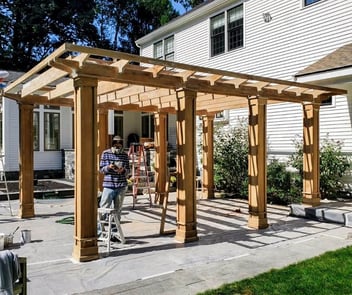
Low-maintenance exteriors have become the gold standard for many customers. That’s why engineered alternatives to wood, like composite, have only become more and more popular over the years. The category has been expanding, will likely continue to expand, and it’s worth understanding the love affair homeowners are now having with it.
Engineered wood is commonly called composite, which is precisely what it sounds like—wood made up of several elements, most often wood fiber and some binding agent. It first came to prominence as an alternative for decks because of its ease of care, cleaning, and upkeep. But when your pine trim begins to rot, the durability that composite brings to decks may be just what you’re looking for.
Composite rarely needs touch-ups, and it doesn’t splinter, rot, crack, or become mildew-infested. What’s more, it’s easy to work with. Less knots and flaws in the material translates to less labor and more flexibility for trim shapes and dimensions. Other than that, it can be cut, nailed, and installed exactly like traditional wood.
In general, composite is pricier than real wood, but the time you save on maintenance is well worth it. Increasingly, composite outcompetes the quality of wood which, over the years, has ebbed significantly thanks to the widespread use of something called fast-grown lumber. Moreover, while new finishes that follow EPA guidelines are safer for the environment, they don’t protect traditional wood as well as engineered wood.
In the constellation of ersatz wood trims, there are a couple of materials other than composite that have gained some traction, including fiber-cement and plastics. Fiber-cement is fire- and rot-resistant, though it may not be as durable as organic wood. Plastics (like, say, polyurethane) are suppler than traditional wood, easily molded into any number of shapes, but because plastics tend to be far more expensive than pine, they’re rarely chosen for trim.
If you have any questions about replacing your rotting trim, don’t hesitate to get in touch with the experts at Tom Curren Companies. We can help you decide what the best option is for you, and talk you through all the pros and cons.